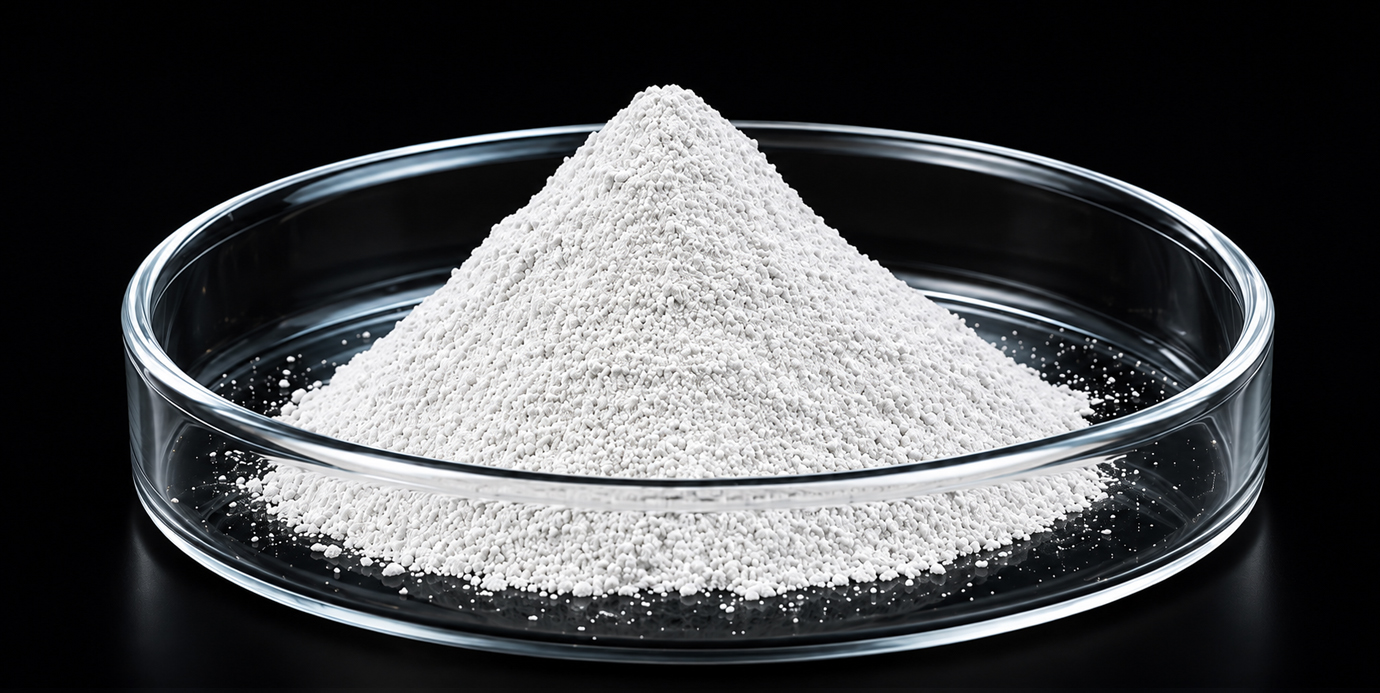
Sorbent Architecture
Matching sorbent behaviour to the application.Selecting and configuring water-selective sorbents around the humidity range, adsorption behaviour, regeneration conditions and performance requirements of the application.
From advanced sorbent materials to integrated systems, Aqueris is building a platform for next-generation humidity control and atmospheric water harvesting.
A metal organic framework (MOF) is a porous material that can capture water from air, but a high-performance sorbent does not automatically create a high-performance system. Performance depends on how the MOF material is formulated, how it interacts with air and heat, how it is regenerated, and how the complete system responds to changing conditions.
Innovation happens between the layers. Each layer supports the next.
Selecting and configuring water-selective sorbents around the humidity range, adsorption behaviour, regeneration conditions and performance requirements of the application.

Formulating, shaping and integrating sorbents into engineered structures while preserving the properties that make them effective.

Engineering heat, airflow, mass transfer and regeneration as an integrated system to maximise useful performance and energy efficiency.

Using sensing, controls and optimisation to adapt system operation to changing environmental conditions, operating requirements and energy availability.
Aqueris engineers these interactions as one integrated technology platform.
At the core of our solutions are Metal Organic Frameworks (MOFs). These are highly porous, sponge-like materials with tiny internal spaces designed to capture particular molecules. Aqueris focuses on MOFs that attract and hold water vapour from the air, then release it when regenerated.
By tailoring the material to different humidity levels and operating conditions, the same underlying technology can support both moisture control and water production.



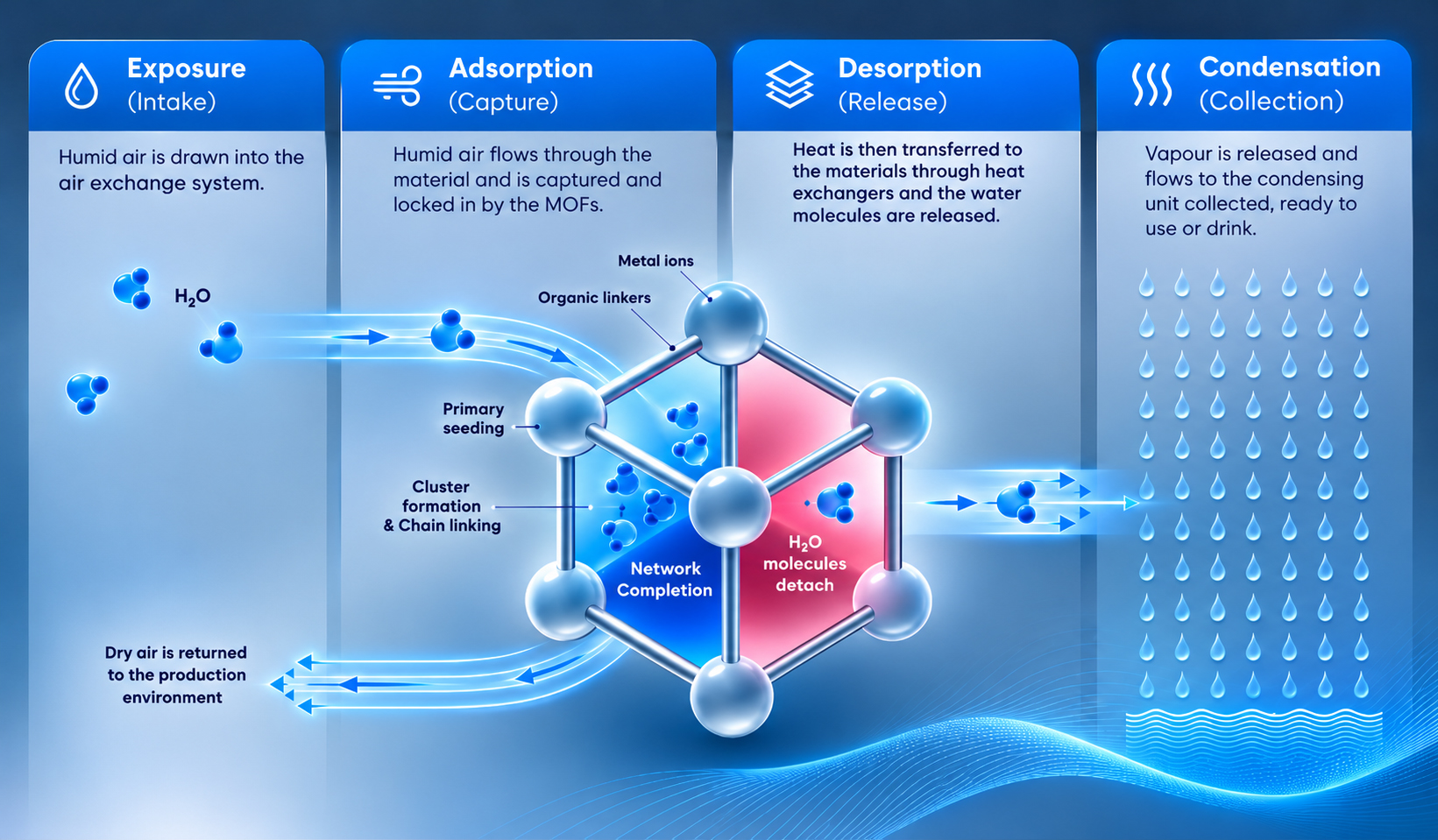
The diagram illustrates how a water-selective MOF captures moisture from the air, then releases it during regeneration. For atmospheric water harvesting, this vapour can be condensed into liquid water. For moisture management, the same capture process helps control humidity.
Continuous closed-loop cycle. After regeneration, the MOF is ready to capture moisture again, allowing the process to repeat.
The underlying mechanism is similar, but the desired outcome is different.
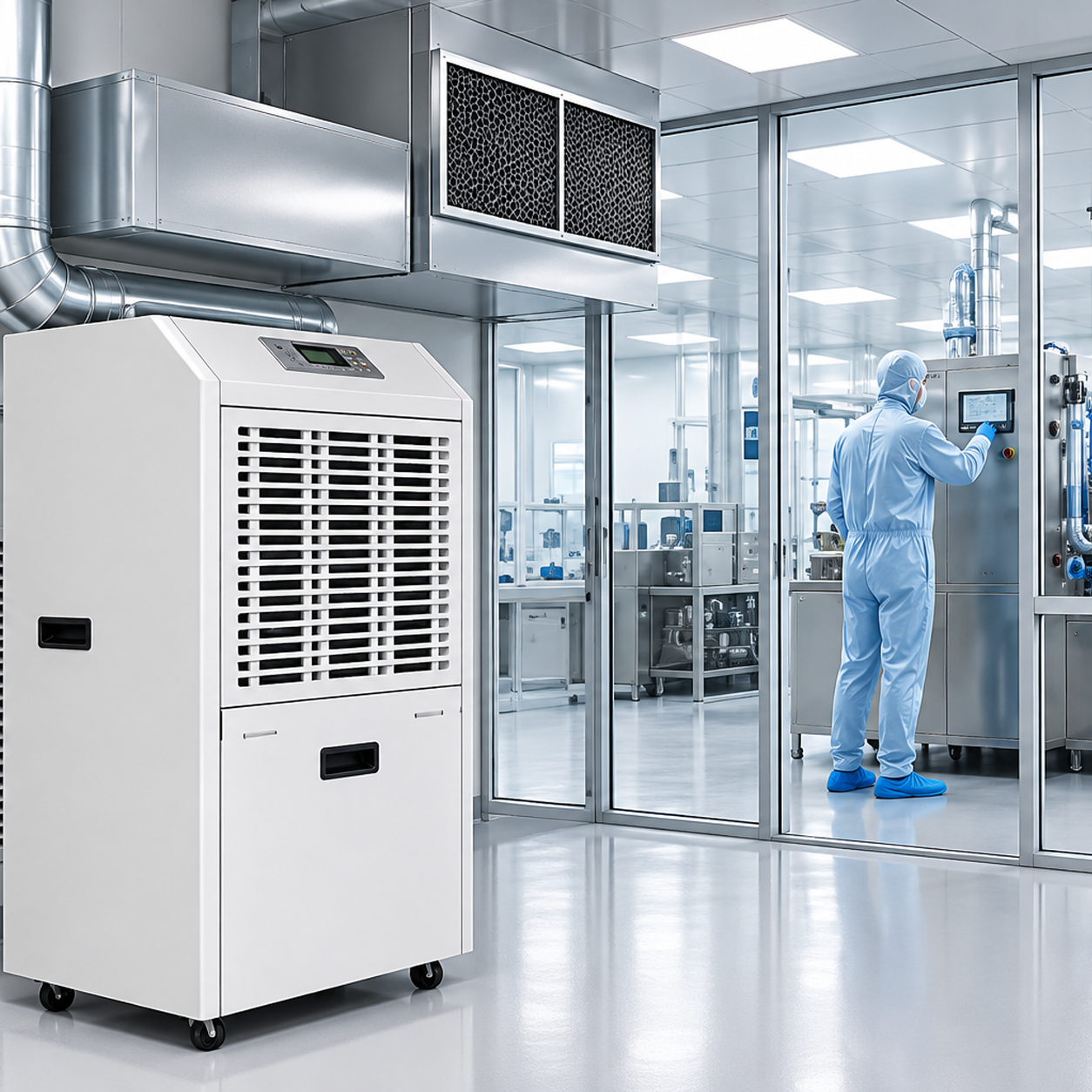
The objective is to control the amount of water vapour in the air. A water-selective MOF captures moisture from an incoming air stream before being regenerated so it can repeat the cycle. This can be used for applications such as industrial dehumidification, humidity control and drying.
The captured moisture becomes the product. Water vapour is adsorbed from the air, released during regeneration and then condensed into liquid water. This creates a pathway for atmospheric water harvesting.
In moisture management, water is removed to control the air. In atmospheric water harvesting, water is removed because the water itself is valuable.
The MOF is only the starting point. Real-world performance depends on how the sorbent is formulated, integrated and engineered into the wider thermodynamic system. Aqueris works across this technology stack, from sorbent architecture and formulation through to system engineering and intelligent control.
High-performing, adaptable commercial water-capture products — clean, low-energy and affordable.
Our proprietary MOF technologies are engineered at the nanoscale for integration into industrial environments.
We focus solely on water-sector applications, developing products to meet each client’s specific needs.
Understanding which sorbent characteristics matter for different operating environments.
Translating powder-level performance into mechanically and thermally useful structures.
Engineering the interaction between sorbent, airflow, regeneration, heat and moisture transfer.
Finding the operating architecture that delivers the required output with the lowest practical energy input.
Dynamically adapting the system to environmental conditions and application requirements.
Partner with us and discover a new world of advanced moisture management and water control solutions